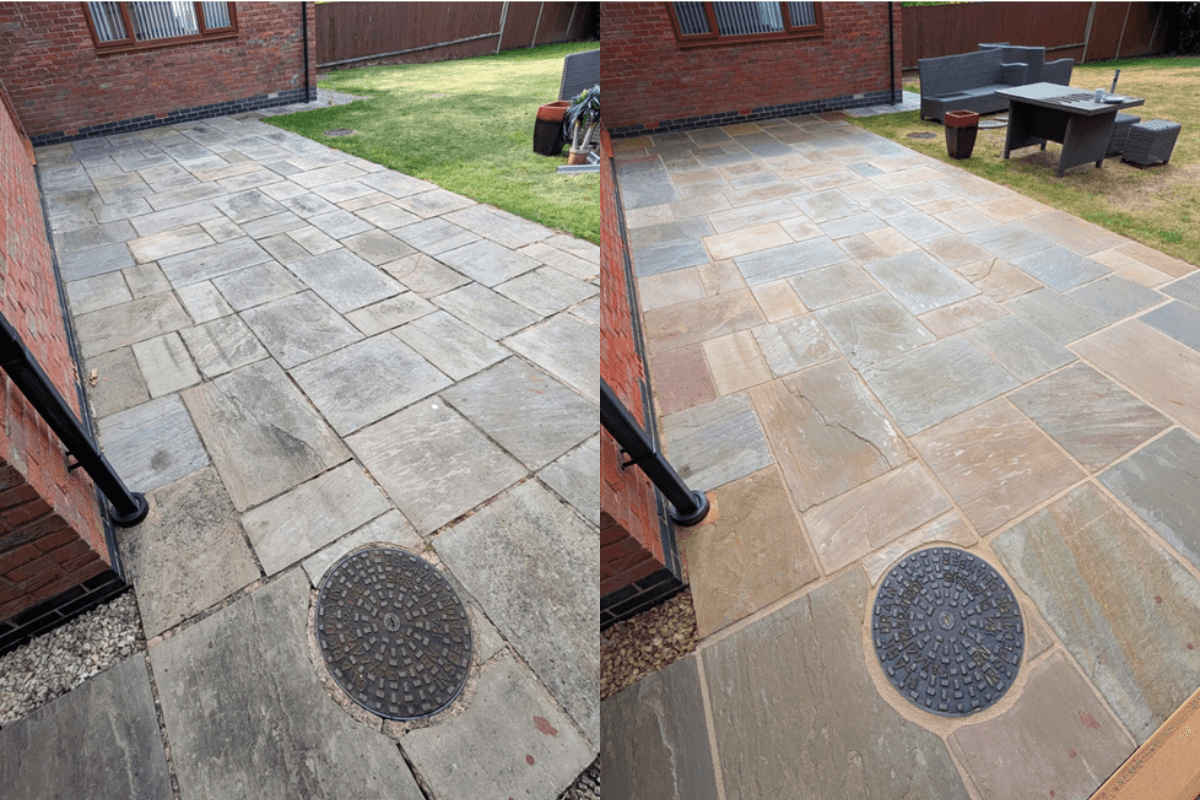
Block paving and pressure washing have a complicated relationship. Most of the damage we’re called to fix wasn’t caused by the bricks getting old — it was caused by someone hammering them with a £100 domestic pressure washer.
What goes wrong
A consumer pressure washer at 1,800 PSI on a focused jet will strip jointing sand out of block paving in seconds. Once the joints are empty, the bricks lose their lateral support, water gets underneath, the sub-base shifts, and the surface starts to sink or lift. The bricks themselves are usually fine. The problem is the joints.
How a pro does it
- Pre-treat with biocide so the chemical does most of the moss/lichen killing — not the pressure.
- Use a rotary surface cleaner with controlled pressure (typically 1,500–2,200 PSI) rather than a focused jet.
- Sweep, never blast — overlap each pass, keep the wand moving, never linger.
- Always plan to re-sand the joints after cleaning — kiln-dried sand as standard, or Nexus Pro joint compound for patio restorations, which sets firmer and holds out the weeds.
Signs your driveway needs re-sanding
- Bricks visibly sitting lower than the kerb or surrounding edge.
- Weeds growing along the joint lines (the sand has gone, soil has filled the gap).
- Bricks rocking under foot when you walk on them.
- Sand visible washed across the surface after rain.
Ready to sort yours?
Quote me for a clean & re-sand →